

List Of Forex Volume Indicators
Final Updated on 7 April, 2022 by
Volume is 1 piece of information that is oft neglected by many market players, specially the beginners. However, learning to translate volume brings many advantages and could be of tremendous help when it comes to analyzing the markets.
At that place are many benefits of volume analysis: Firstly, information technology helps to confirm toll trends and chart patterns, as it shows how much interest the security is attracting. Secondly, changes in volume tends to lead the price movements. And thirdly, the trend in a volume indicator over a long period is relevant to the price trends and helps determine when the price is losing momentum.
Swingtrader Pro Trading Signals
Have a $ane Trial for a Month
- Live track record since 2013!
- 100% Quantified and Backtested
- Nosotros e'er show our results!
- Articulate Instructions via email!
- Quit when you want to
Experienced traders and investors often use book analysis to get alee of others. So nosotros created this guide to teach you lot what you need to know about volume trading. In this guide, you lot volition acquire:
- What volume ways
- The common volume indicators
- How to use volume indicators in trading
So let'southward brainstorm by having a closer expect at what book is and how it tin help traders!
What Does Volume Mean in the Market?
The marketplace is fabricated up of buyers and sellers; for a transaction to occur, there must be a willing buyer and seller. A unit of volume, therefore, represents a transaction between a heir-apparent and a seller.
The term 'book' means different things for securities that trade in unlike marketplaces. For forex and other securities that merchandise over the counter (OTC), the volume might mean the number of ticks (price changes) that occurs in a given time interval. The reason is that at that place's no centralized exchange where transactions are recorded. And more than chiefly, the volume information represents what happens at a particular liquidity provider only.

For stocks and other securities that trade on standard exchanges, such as futures and options, the volume is a measure of the number of shares or contracts transacted over a specified menses of fourth dimension. In order words, it shows how many times the security has been bought or sold over a given timeframe. The timeframe can be one minute, four hours, ane day, or annihilation.
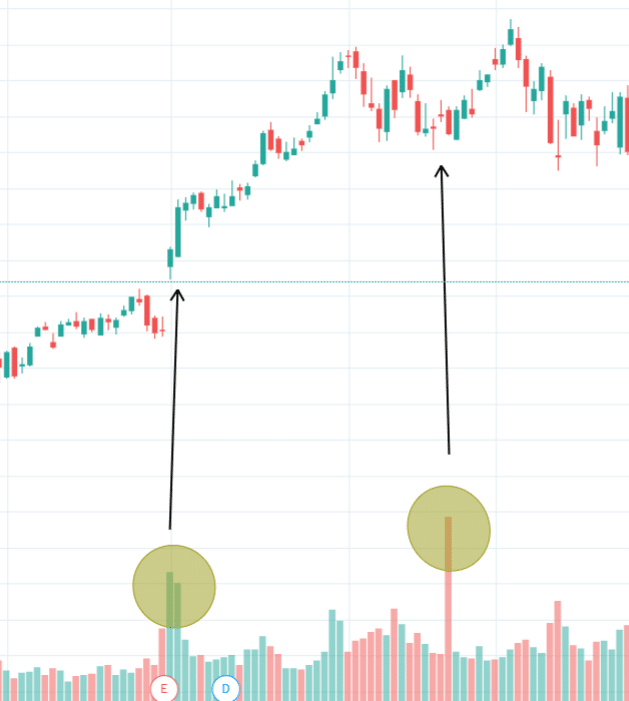
In most charting platforms, the volume indicator is presented in a separate window beneath the price chart, just like other indicators used in technical assay. The volume transacted in the given timeframe is represented equally a bar, which tin can be color-coded.
The color of the bar shows whether the security's price closes up or downwardly. A greenish bar is by and large used to evidence that the security closed higher during the trading session while a red bar is used to bespeak that the security closed lower. The height of the bar shows whether there's an increase or a subtract in volume of the security transacted — a taller bar shows a higher book while a shorter bar shows a lower volume.
The Significance of Little Book
It makes lilliputian sense to analyze the volume lone. To correctly interpret the volume data, information technology must be seen in the lite of what the price is doing. And then the implication of a small trading volume depends on the price movement.
If the toll is ascension in an uptrend but the book is reducing or unchanged, information technology may show that there'southward picayune interest in the security, and the toll may reverse. Similarly, when the cost is speedily declining but the volume is low, it could mean that the institutional traders are non interested in the cost direction. And so the price will shortly opposite to the upside.
The Significance of High Volume
A high volume commonly indicates more interest in the security and the presence of institutional traders. How the volume will affect the price movement depends on the market situation. In an uptrend, an increasing price accompanied by a rise volume may be a sign of a healthy uptrend. In the same way, a declining price in a downtrend occurring with an increasing volume indicates a possible downtrend continuation.
However, for a prolonged uptrend or downtrend, the example is different. A quickly rising price in an uptrend accompanied past a huge volume may be a sign of burnout — a situation known equally a buying climax. Similarly, a quickly declining toll in a prolonged downtrend occurring with a huge book might mean capitulation — a situation where hesitant investors finally give up on the market and massively sell their stocks.
To help traders and investors better translate the volume of the market, there are many volume-based indicators yous could utilise. Let's take a look at some of the near common volume indicators around.
Book Indicators
Apart from the volume itself, there are a lot of other indicators that are based on the volume data. Analyzing those volume indicators has always helped traders and investors to better understand what is happening in the market place. Here are some of the commonly used volume indicators:
- OBV indicator
- Volume RSI
- Volume price tendency indicator
- Money flow alphabetize
- Chaikin coin catamenia indicator
- Accumulation/distribution
- Ease of movement
- Negative volume index
- Volume-weighted boilerplate toll
OBV Indicator
The OBV indicator, popularly known as on-balance volume, is a technical analysis indicator that relates book flow to changes in a security's price. Information technology uses a cumulative full of positive and negative trading volume to predict the direction of price. The OBV is a volume-based momentum oscillator, and then it is a leading indicator — it changes direction before the price.
This book indicator was created by Joseph Granville in his 1963 volume titled, "Granville's New Key to Stock Marketplace Profits". Granville proposed the theory that changes in volume precede price movements in a measurable fashion. He believed that volume was the main force backside major marketplace moves and thought of OBV's prediction of cost changes as a compressed jump that expands quickly when released.
He gave the formula OBV equally:
OBV = OBVpre +
Where:
OBV = current on-residual volume level
OBVprev = previous on-rest volume level
Volume = electric current trading volume
How OBV is Calculated
OBV is a running total of the trading volume and shows whether there'south an inflow or outflow of volume. Then, depending on how the current price closes relative to the preceding session'due south close, there are iii ways the current OBV tin can be calculated:
- If the current session's closing cost is higher than the preceding session's closing price, then: Current OBV = Previous OBV + Current session'south volume
- If the current session's endmost price is equal to the preceding session'southward closing price, so: Electric current OBV = Previous OBV
- If the current session's endmost price is lower than the preceding session's closing price — Current OBV = Previous OBV – Current session's book
How to Translate the OBV
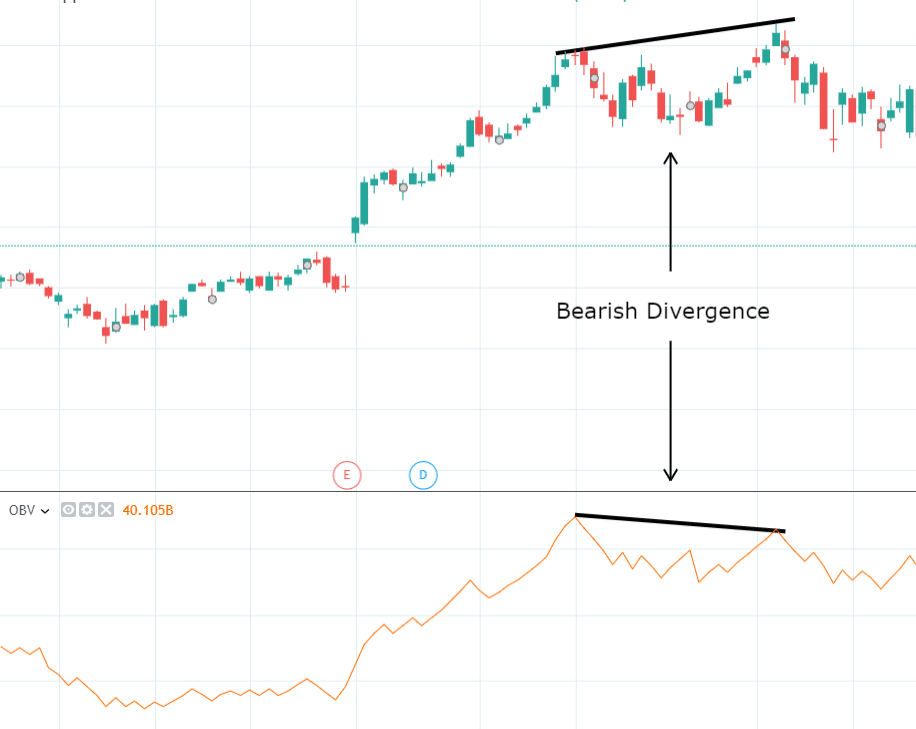
It is believed that the OBV shows the interactions between the institutional and retail traders in the market. The OBV is plotted as a line chart on a separate window from the chief price chart. Existence a cumulative total volume, the OBV indicator should exist going up when the price is going upward and be going down when the price is falling.
If the cost makes a new loftier, the OBV should likewise brand a new high. If the OBV makes a lower loftier when the price makes a higher high, at that place's a classical bearish divergence — indicating that only the retail traders are buying. Some other type of bearish divergence occurs when the price remains relatively serenity and fails to make a higher high but the OBV soars higher than the previous loftier — indicating that the institutional traders are accumulating short positions. In both situations, the chances are loftier that the cost will plough downwards.
On the other mitt, if the price makes a lower low and the OBV makes a higher depression, at that place is a classical bullish departure, showing that the institutional traders don't believe in that move. Also, if the OBV makes a lower depression when the price is relatively unchanged or makes a college low, a not-classical bullish difference occurs, indicating that the smart money (institutional traders) is accumulating long positions.
Volume RSI
The volume RSI is a volume indicator that measures the speed and alter of volume during the price upwards-close (up-volume) and during the price downward-close (downwards-volume). It is a momentum indicator that tries to estimate changes in price trend via changes in bullish (when the price closed upwardly) and bearish (when the price closed down) volume data.
In other words, the volume RSI is similar to the price-based RSI, except that changes in book information are used instead of changes in price. However, the direction of the modify (up-book or down-volume) is determined past the direction of cost shut. So this volume indicator compares the volume traded during trading sessions when cost closed college to the volume traded when price closed lower to know which is stronger.
How is Volume RSI Calculated?
Volume RSI is calculated similar the price-based RSI, the departure being that book data is used instead of price data. The calculation follows a iv-step process:
- Computing the up-shut and down-close changes in volume
- Getting the due north-menses smoothed moving boilerplate of the up-volume and downwards-volume
- Calculating the relative strength factor (RS)
- Calculating the RSI
- Calculating the up-volume and down-volume:
If price closed upwards, Up-book = current volume – previous volume, and Down-volume = 0
If price closed downwardly, Down-volume = previous volume – current volume, and Up-volume = 0
If price closed unchanged, Upward-volume = 0, and Down-book = 0
- Getting the n-flow smoothed moving average (SMA) of the upwards-volume and down-volume:
The kickoff averages are calculated equally follows:
Get-go Average Up-volume = Sum of Up-volumes over the past northward periods / n.
Starting time Average Down-volume = Sum of Downward-volume over the past n periods / northward
The other averages are calculated from the previous averages and the current Up-volume/Down-volume:
Average Upwardly-volume = [(previous Average Up-book) x (n – 1) + current Upwardly-volume] / north.
Average Down-volume = [(previous Boilerplate Downward-volume) x (due north – 1) + current Downward-book] / n.
- Computing the relative force gene (RS):
The relative strength gene is the ratio of the Up-volume Averages to the Down-volume Averages:
RS = SMMA (Up-volume, due north)/SMMA (Downwards-volume, n)
- Calculating the RSI:
RSI = 100 – [100/(ane + RS)]
How to Interpret Volume RSI
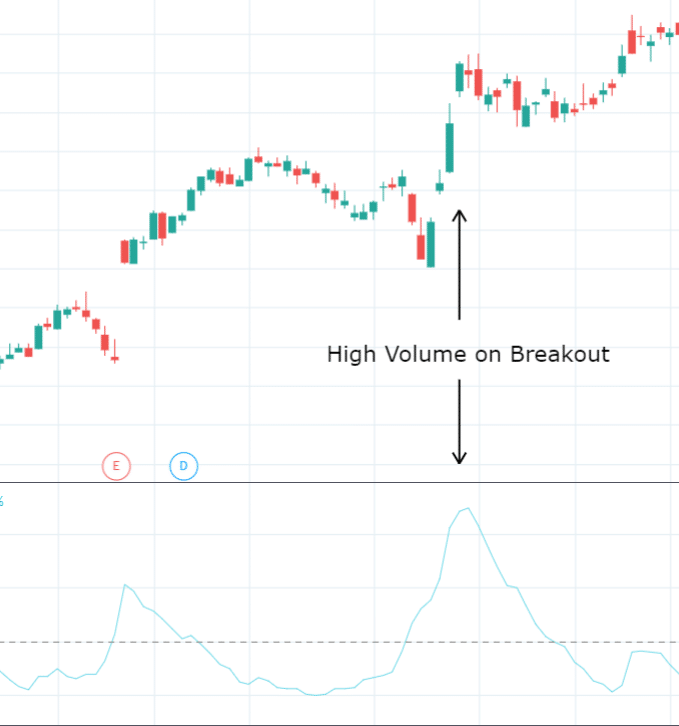
The volume RSI is interpreted the same way every bit the price-based RSI. Simply like the toll type, the volume indicator oscillates between 0 and 100% and around the 50% line. Below the 30% line is considered oversold while to a higher place the seventy% line is considered overbought.
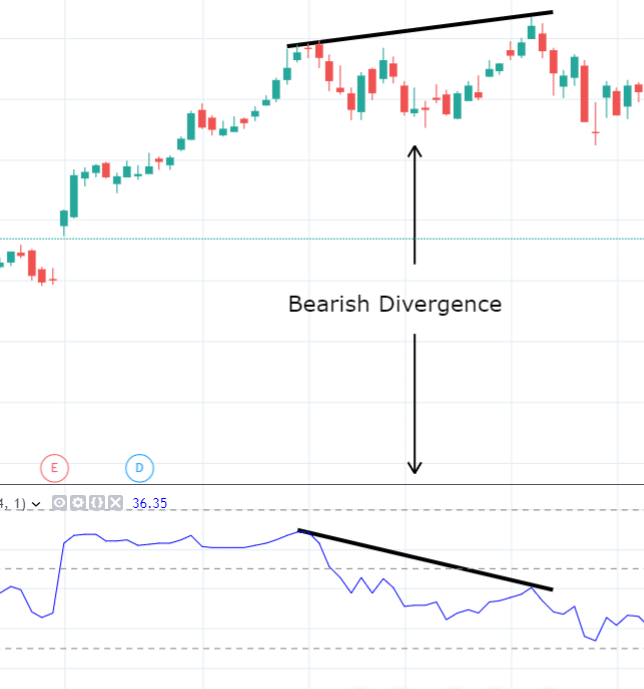
When the indicator is rising from the oversold region and crosses the 50% line, bulls are dominating. On the other manus, when the indicator is coming down from the overbought region and crosses the 50%, bears are dominating.
In the image below you can come across the same divergence every bit nosotros showed you with the OBV indicator
Book-Price Trend Indicator (VPT)
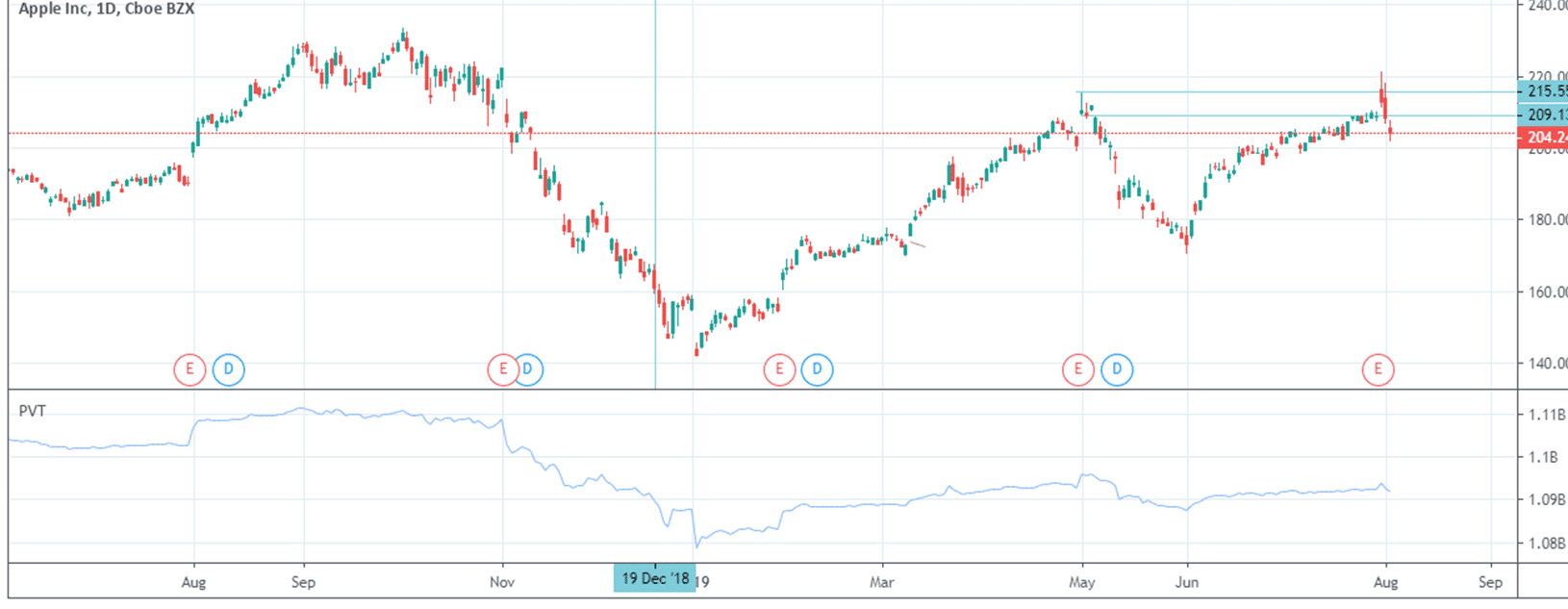
Volume-toll trend, also chosen cost-book trend (PVT), is a book indicator that relates the book of security transacted with the fractional change in price. It helps to determine both the price direction and the strength of the price movement. Thus, the VPT shows the residuum between the need and supply of the asset and how information technology affects the price.
This book indicator is a running cumulative value, then it adds or subtracts a product of the current volume and a fractional change in price to the previous VPT value — depending on the direction of the security's close toll — to go the current VPT value.
How to Calculate the Volume-price Tendency Indicator
The volume-price tendency indicator is calculated as follows:
VPT = VPTprev + Volume x {(Price Closecurrent – Price Closeprev)/Cost Closeprev}
Where:
VPT = Current value of the Volume-price Trend
VPTpre = Previous value of the Volume-cost Trend
Volume = Current Session'south Volume
Price Closecurrent = Current Session's Closing Price
Price Closeprev = Preceding Session'southward Closing Price
Just like the on-rest volume, the kickoff point in the indicator is taken arbitrarily, so the actual value of the indicator is not that of import — the shape of the line graph is what matters. Different the OBV which uses book alone in accordance with the management of price close, the VPT factors in the extent of the higher or lower toll close.
What Does the Volume-cost Indicator Tell You?
The estimation of this volume indicator is similar to that of OBV. The primary idea is there's a higher volume when the price is moving in predominant trend management and less volume when the price is moving against the main tendency. So if the main tendency is up, the volume is expected to be high for a trading session that closes up, and in a downtrend, the volume should exist high for sessions that close lower.
Since the VPT is a cumulative direction-based value, information technology should be going up when a session is trading upward in an uptrend and be going down when a session is trading down in a downtrend. If the price makes a higher loftier in an uptrend, the VPT should likewise; if not, a bearish difference is created which might signal a price reversal. The opposite is the example in a downtrend — if the price makes a lower low, the VPT should also make a lower low, and if it doesn't, a bullish departure is formed
Book Oscillator (VO)
The volume oscillator is a book indicator that displays the difference between two volume-based moving averages as a percentage of the slower moving boilerplate. It consists of two moving averages of the volume data, 1 fast and the other slow. The divergence between the two moving averages is expressed every bit a percent of the slower moving average.
In essence, the indicator is like to the OsMA (oscillatory moving average indicator), except that book information is used instead of cost. Sometimes, chartists add a moving average of the deviation to serve every bit a signal line, thereby making the indicator look more than like a book-based MACD, and calls the indicator percentage volume oscillator (PVO).
How to Summate the Volume Oscillator
VO = {(brusque EMA of volume – long EMA of volume)/long EMA of volume} x 100
Where:
VO = volume oscillator
Short EMA of volume = short-period exponential moving boilerplate of book (usually 12 or fourteen periods)
Long EMA of volume = long-period exponential moving average of volume (usually 26 or 28 periods)
In the PVO indicator, a 9-menses moving average of the VO is added as a signal line.
How to Interpret the Volume Oscillator
The VO is normally displayed every bit a single line that oscillates effectually the zero line, but it can also be displayed as confined in a higher place and below the zero line. When the indicator is at the zip level, it means that the faster moving average is crossing the slower moving boilerplate, equally the difference between the moving averages will be nix.
When the indicator is ascension above the cypher line, the faster moving average is rising higher up the slower moving average — indicating a short-term surge in volume. Falling beneath the zero line means that the faster moving average is falling below the slower one, showing a refuse in volume.
It is expected that strong toll moves, upwardly or down, should be accompanied past an increase in volume. And then the indicator helps to confirm the force behind price movements. An increase in price in an uptrend or a subtract in cost in a downtrend accompanied past a rise in the book oscillator is a sign of strength in the trend management. When such moves are accompanied past a subtract in the book oscillator, there'southward a weakness in that trend management.
Money Flow Index (MFI)
The money flow index is a volume indicator that oscillates between 0 and 100. Information technology is used to indicate the management of money flow by estimating the values of recent transactions and the cyberspace direction of the transactions. Information technology uses both price and volume data to place overbought and oversold regions.
This volume indicator was created past Gene Quong and Avrum Soudack. Using the aforementioned logic as the relative force index (RSI), the MFI is often referred to equally the volume-weighted RSI by some analysts considering information technology uses both toll and book information in the calculation.

How to Calculate the Money Menses Alphabetize
The money flow index is calculated like the RSI, and it follows a 4-stride process:
- Calculate the typical cost
- Calculate the positive and negative coin menses
- Calculate the money catamenia ratio
- Calculate the coin flow index
- Calculate the typical price:
This is the average of the high, low, and close prices of the trading session. The formula is as follows:
Typical price = (high + low + close)/3
- Summate the positive and negative money catamenia:
Money flow = typical price x volume
But yous need to get the positive and negative money flows:
- Positive coin flow is gotten past calculation the money period of all the sessions where the typical price is greater than the preceding session's typical price
- Negative money flow is gotten past adding the money flow of all the sessions where the typical price is less than the preceding session's typical price
- For sessions where the typical toll is the same every bit the preceding session, the money catamenia is not calculated
- Summate the money ratio:
This is a ratio of the positive coin period to the negative money menses, and it's given as:
Coin ratio = positive money menstruation / negative money flow
- Summate the money period index:
Money flow index (MFI) = 100 – [100/(1 + coin ratio)]
How to Interpret the MFI
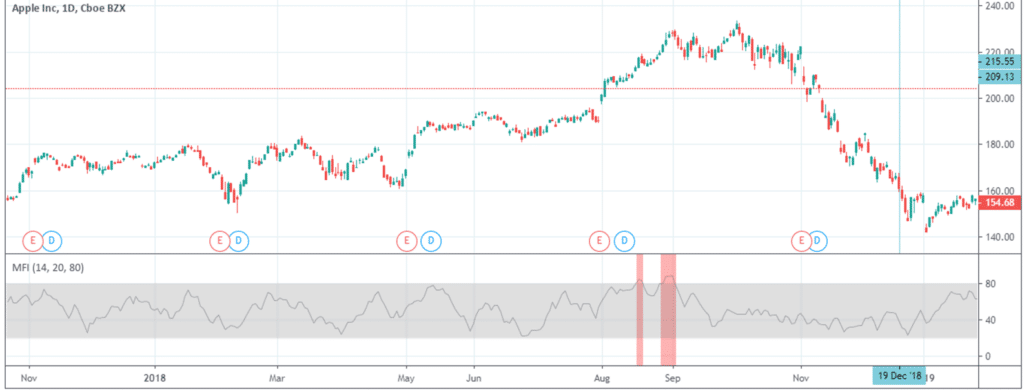
The indicator shows how much a security is traded and the pct that traded to the upside. Generally, a value of fourscore and in a higher place is considered overbought while xx and below is considered oversold, but the creators of the indicator recommended 90 and x for overbought and oversold levels respectively.
In improver to the overbought and oversold regions, a deviation betwixt the cost and the indicator is important. For instance, if the price is making a higher high but the indicator is making a lower high, the movement is weak, and the cost may reverse.
Chaikin Money Flow Indicator
The Chaikin money flow indicator (CMF) is a volume indicator that measures the money catamenia volume over a called period, usually 20 or 21 periods. Created by Marc Chaikin, the indicator uses the money flow volume — which also forms the footing for the aggregating distribution alphabetize(covered soon) — but instead of a cumulative total, the CMF gets the sum of the money catamenia volume.
The coin flow book is a measure out of the volume and where the price closed relative to the trading session'southward range. Information technology comes from the idea that buying pressure is indicated past a rising volume and recurrent closes in the upper part of the session'south cost range while selling pressure is demonstrated by an increasing volume and repeated closes in the lower part of the price range.
Both buying and selling pressures are accompanied by an increment in book, but the location of the closing prices are in accordance with the direction of toll. So the indicator oscillates about the zero line — above zero indicating a bullish tendency and below, a surly trend.
How Chaikin Money Menstruation is Calculated
Calculating the CMF is a three-stride process:
- Calculating the close location value (CLV), also known as the money flow multiplier
- Calculating the money flow volume
- Computing the CMF
Stride i: Calculate the shut location value
This show where the price closed relative to the session'due south range. It is gotten equally follows:
CLV = [(Close – Low) – (High – Close)] / (Loftier – Low)
Step 2: Calculate the money menses book
Money flow volume = CLV x Volume
Stride iii: Summate the Chaikin Money Menstruation
CMF = (north-menses sum of Money Period Book) / (n-menses sum of Book)
Where:
n is the flow of selection, usually xx or 21.
How to Interpret the Chaikin Money Flow
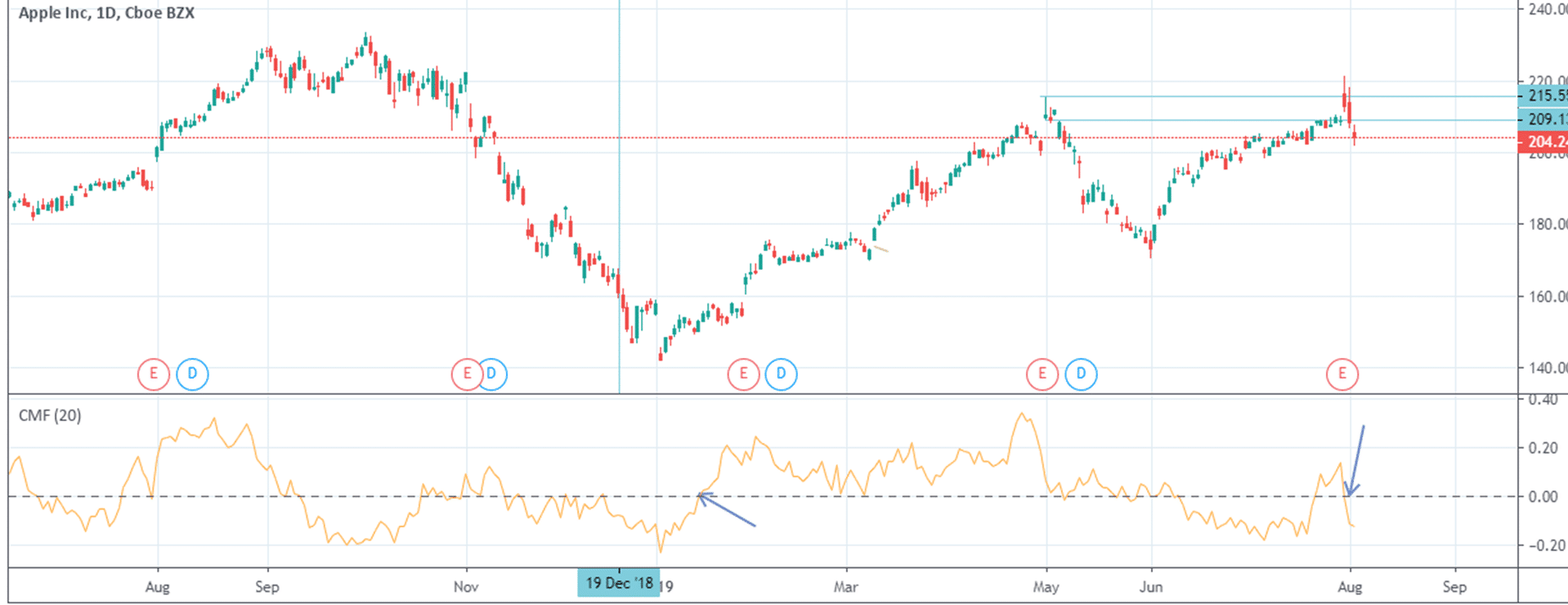
This volume indicator oscillates between +1 and -1 but may never attain these extremes as it would take consecutive closing at the upside or downside for the entire due north-menstruation for the CMF to get to a +1 or -1 value respectively. For the most function, it will merely oscillate between +0.4 to -0.iv, with 0 as the centerline.
When the indicator rises in a higher place the zero line into the positive territory, there is a rise ownership pressure and waning selling pressure. Conversely, when information technology descends below the nil line, there is a ascension selling pressure level and a declining bullish pressure. The indicator can likewise evidence bearish and bullish divergences.
Accumulation/Distribution (A/D)
Beingness a volume indicator, the accumulation/distribution index relates the volume of a security transacted to the changes in its toll. It uses volume and cost information to determine whether a stock is currently beingness accumulated or distributed. Because it uses book to gauge price momentum, it is a leading indicator.
The index tries to assess the demand and supply of the security past checking where the price airtight during the session'due south range and how much volume was traded in the session. Merely like the OBV, the A/D is a running cumulative value in which the current value is added to the previous value to get the current cumulative total.
How to Calculate the A/D
A/D = Previous A/D + CMFV
Where:
CMFV = Current Money Flow Volume
{[(Shut – Low) – (High – Close)] / (High – Low)} x 5
To simplify the adding of the A/D, we demand to break it down to three steps:
- Get the close location value (CLV) — this is also known as the money menstruation multiplier
- Calculate the current money menstruation volume (CMFV)
- Compute the current A/D value
Step one: Get the Close Location Value
It measures the level of closing price relative to the range.
CLV = [(Close – Low) – (High – Close)] / (High – Low)
Step two: Summate the Current Coin Period Volume
CMFV = CLV x Book
Step 3: Compute the Current A/D Value
A/D = Previous A/D + CMFV
The starting bespeak in the A/D is capricious, then the actual value of the A/D is non that important. It is the shape of the A/D line that matters.
How to Translate the A/D Line
The indicator shows how the toll closes and the force behind the move. Considering it is gotten from the product of the close location and the volume, the indicator rises faster if price closes well-nigh the high with a big book — indicating a potent buying force per unit area. If, on the other mitt, the price closes near the low of the session'south range with a large volume, the A/D line will reject faster, showing a strong selling pressure.
The indicator helps in assessing price trends and potential toll reversals. When the cost is in an uptrend, the indicator should as well be in an uptrend. If the indicator is in a downtrend, it may indicate a selling pressure (distribution), and the price is likely to reverse to the downside. Conversely, if the price is in a downtrend and the A/D line is ascending, it shows in that location may be a buying force per unit area (accumulation), and the price may soon rise.

Ease of Movement (EOM)
Adult by Richard Artillery, the Ease of Movement indicator (also known equally the Ease of Movement Value (EMV)) is a volume indicator that tries to apply both momentum and volume information to ascertain how hands the cost tin can motion in a particular direction. It oscillates above and below the aught line, corresponding to bullish and surly movements respectively.
In theory, if the price is able to move up easily, there is fiddling selling pressure; thus, it will continue to rise. Similarly, if the cost tin fall hands, at that place's little ownership force per unit area, and so it may continue to fall. The EOM is usually seen as a book-weighted momentum indicator because of the way it is calculated.
How to calculate the EOM
The EOM formula has three components, namely: distance moved, volume, and the high-low range. The calculation is normally washed in four steps:
- Calculating the distance moved
- Calculating the box ratio
- Computing the i-flow EOM
- Computing an n-period EOM
Step one: Calculate the distance moved
This will form the numerator of the EOM and is gotten by comparison the current session'southward midpoint with the preceding session'south midpoint, as follows:
Distance Moved = [(Current High + Current Depression)/2 – (Preceding High + Preceding Depression)/2]
Step 2: Calculate the box ratio
This involves the volume and the loftier-depression range components of the formula, and it forms the denominator of the EMV. It is gotten every bit follows:
Box Ratio = [(V/100,000,000) / (Electric current Loftier – Current Depression)]
Step 3: Summate the 1-menstruation EOM
1-Catamenia EOM = Altitude Moved / Box Ratio
Footstep iv: Compute the n-period EOM
Generally, a xiv-menses is used.
fourteen-Period EOM = xiv-Period Simple Moving average of the 1-Period EOM
How to Interpret the EOM
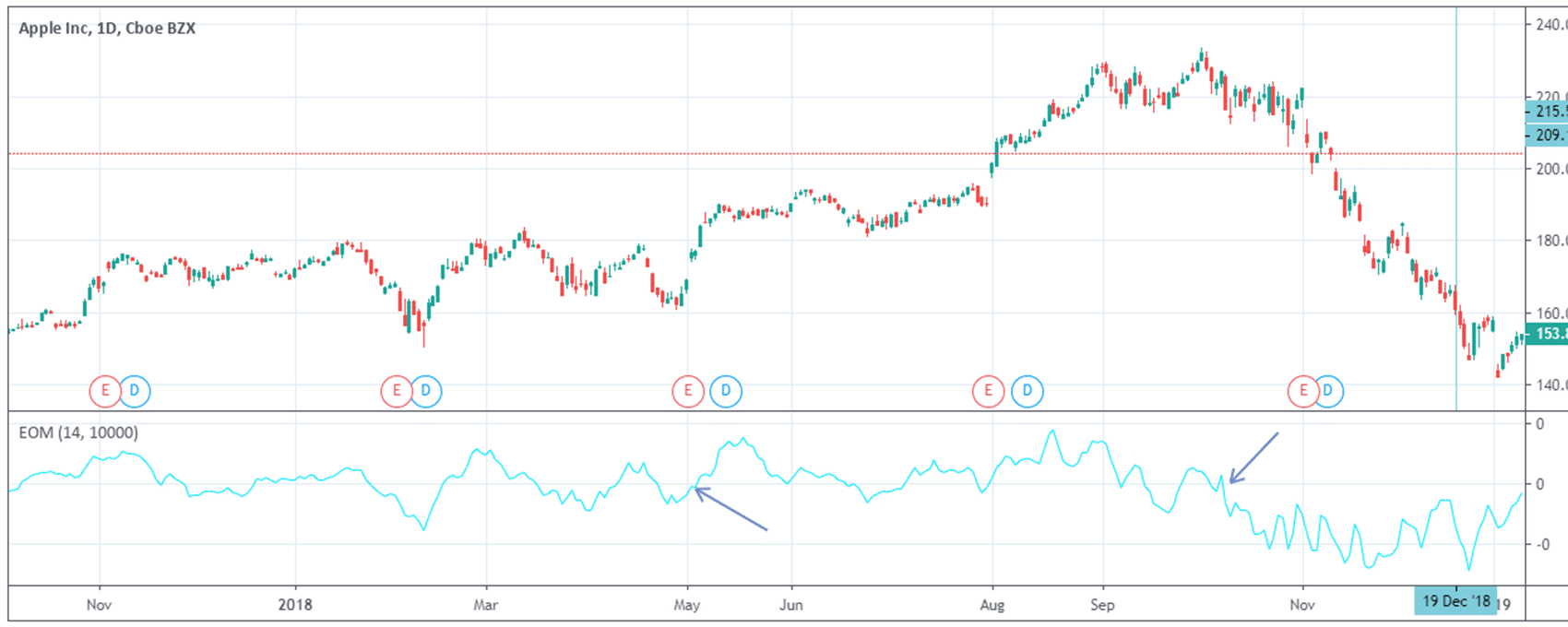
The EOM is larger when the denominator, the box ratio, is smaller. And the box ratio is smaller when the volume is relatively low and the loftier-low range is relatively large. A wide price range on low book would imply an like shooting fish in a barrel cost movement since it didn't take a big volume to motility the price. The opposite is also true when in that location'due south a small price range on loftier book, showing difficulty in the price movement.
When the EOM climbs above the zero line and continues rising, information technology suggests that the price is ascent on low volume, so there's an ease of movement to the upside. Conversely, when the indicator falls below the zero line and keeps descending, at that place's an ease of movement to the downside.
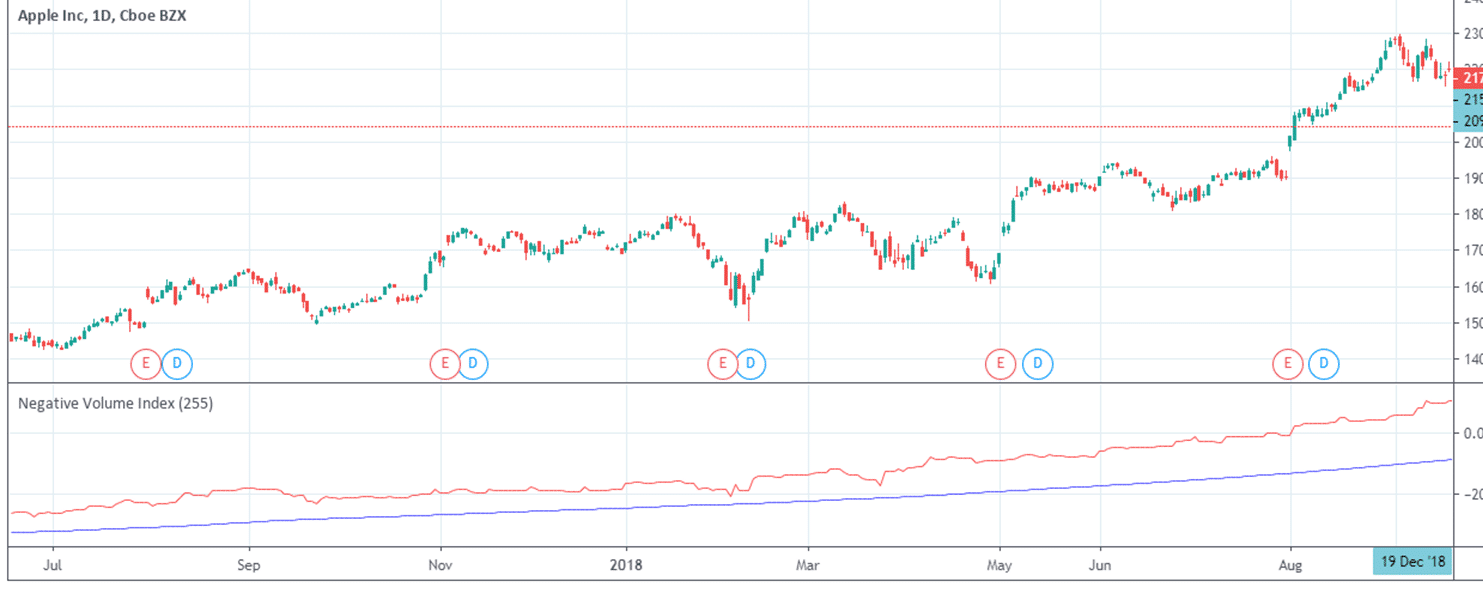
Negative Book Index
This volume indicator combines both volume and price information to graphically show how sessions with low volume tin affect price movements. It tries to apply the changes in book to track what the smart coin (institutional investors) is doing. It can exist used in combination with the positive volume index.
Both indexes were developed in the 1930s by Paul Dysart but weren't well-known until afterwards his expiry in 1969 — when Norman Fosback shed lite on them in his volume, "Stock Market Logic". Being a cumulative indicator, the current value is added to the previous value to get a running total.
How to Summate the Negative Book Index
The calculation of this volume indicator depends on how the current mean solar day's volume varies with the preceding mean solar day's volume. The negative volume alphabetize makes apply of merely the book that is lower than the previous 24-hour interval'southward value. If the current day's volume is higher than the previous day's volume, the day is omitted in the calculation. And if the current volume is the aforementioned as the previous day's value, the day is too omitted.
For those days that take a lower book than the preceding twenty-four hour period, the negative volume index (NVI) is calculated as follows:
NVI = NVIprev + {[(TCP – YCP) / YCP] x NVIprev}
Where:
NVIprev = Previous NVI
TCP = Today'south close price
YCP = Yesterday's shut price
What the Negative Volume Index Tells You
When the negative volume alphabetize is increasing, it shows that the cost is going upwards on a low volume. And when the negative volume index is declining, information technology's an indication that the price is falling with decreased volume. According to Dysart, the NVI needs to rise above its prior high to ostend a potential bullish tendency and fall below its prior depression to ostend a bearish trend.
The NVI is believed to assistance track the smart money, and it's particularly useful after the cost has come down from high volume trading. In such a situation, low volume days tin can show how institutional investors are trading the security. But the best affair is to combine the negative book alphabetize and the positive volume index so every bit to appreciate how volume changes can affect the price.
Book-Weighted Average Price (VWAP)
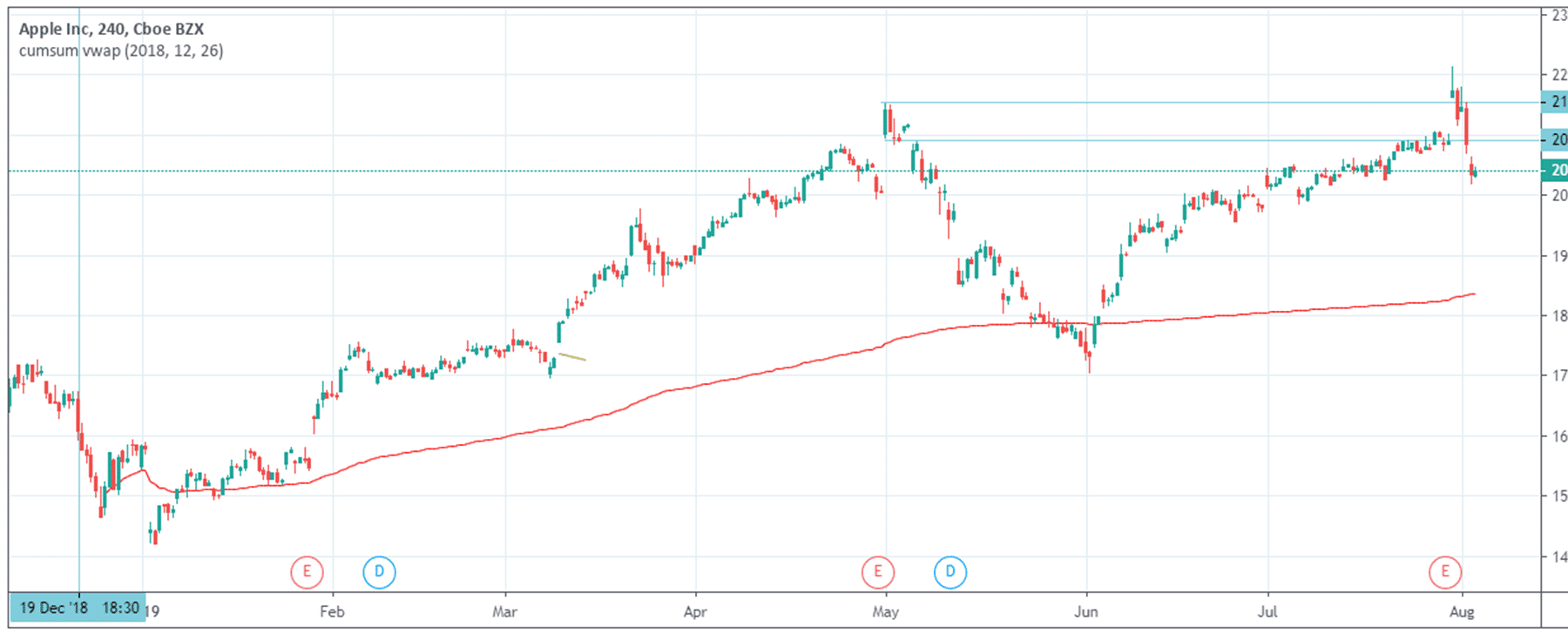
Being a volume indicator, the volume-weighted average price represents the average price an asset has traded at throughout the trading session (usually a day) when both the toll and the volume are taken into account. It is the ratio of the dollar value traded to the total volume transacted over the trading period.
The VWAP gives traders some insight about the trend and value of a security. Institutional investors use the indicator to assess whether they bought at a good price for the day or have overpaid for the stock. It's good to note that this volume indicator is plotted straight on the price chart.
How the Volume-weighted average Price is Calculated
The VWAP is calculated by summing up the dollar value traded in the session (the average price multiplied by the number of shares transacted) and dividing past the total number traded. The formula is given as follow:
VWAP = [Sum of (Pricetypical x volume)] / sum of volume
The Calculation Involves Five Steps:
Footstep 1: Summate the typical price for the chosen intraday period past finding the average of the loftier, low and close prices:
Typical Price = (High + Low + Close) / 3
Pace 2: Multiply each period's typical price by the volume
Stride 3: Get a cumulative total of the values in step ii
Step 4: Get a cumulative full of the volume data
Step 5: Divide the values in stride 3 past the value in step 4
What Does the VWAP Tell You lot?
It shows the actual value the security is trading at, and so it can tell if the security was bought or sold at a fair price. Stock analysts and traders use the VWAP to eliminate the noise in the market place then that they can get an thought of what prices buyers and sellers are willing to transact.
When the VWAP is ascent or the cost crosses above the VWAP line, it shows that the price may be in an uptrend. On the other hand, if the VWAP is failing or the toll crosses below the VWAP line, it suggests that the price may potentially be in a downtrend.
How to Utilise Volume and Volume Indicators in Trading
Adding i or ii of these volume indicators in your assay tools could be of great help in your trading. At the very least, a volume indicator tin help you confirm the validity of a setup before you place a trade or give you an early on alarm almost trades that aren't progressing well.
Permit'south take a wait at some scenarios where a book indicator can help your trading decisions:
Breakouts and Breakdowns
In trading breakouts, most traders look for the toll to close to a higher place a resistance level before placing their trades. Similarly, the cost must close below a support level to be a breakup. However, how the price closed might not be plenty to confirm the validity of a breakout or breakdown.
Y'all could add together book to the flick: a breakout or breakdown that occurs with a huge volume is more than likely to succeed than one that occurs with a trivial book. The reason is simple: an increase in volume during a breakout indicates strength in the motion while a decrease in volume shows a lack of interest in the movement.
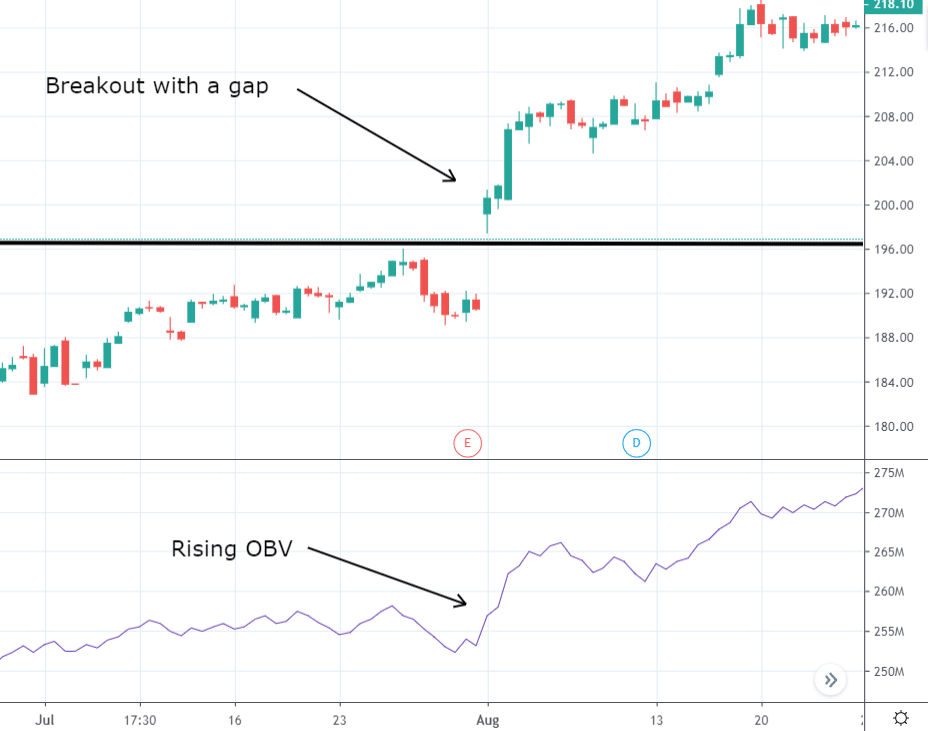
The chart above is for Apple, and you can see the resistance line at $196. Tin can you see that there's a breakout with a gap at the beginning of August 2018? Notice the way the OBV was ascending (high book) when the breakout occurred, indicating that there's enough strength backside the motion. Meet the next chart for a breakdown.

The to a higher place nautical chart is still for Apple. You can come across how the price came down to a support level, and the volume oscillator was rising when the breakup occurred, showing the conviction of the bears. The price expectedly went down in the following sessions.
Trading Simulated Breakouts
False breakouts occur frequently in the market, partly because of the liquidity it offers institutional players. Acute retail traders take learned to track this particular signature of the smart money to ride with them. In some situations, these false breakouts create patterns, such as hikkake blueprint, which tin can be quite profitable when spotted.
Volume indicators don't just help y'all to avoid trading certain breakouts that are doomed to fail just also helps you ostend whether the contrary direction presents a profitable trading setup. In other words, a book indicator can assistance y'all identify a unlike trading opportunity when a breakout has failed.
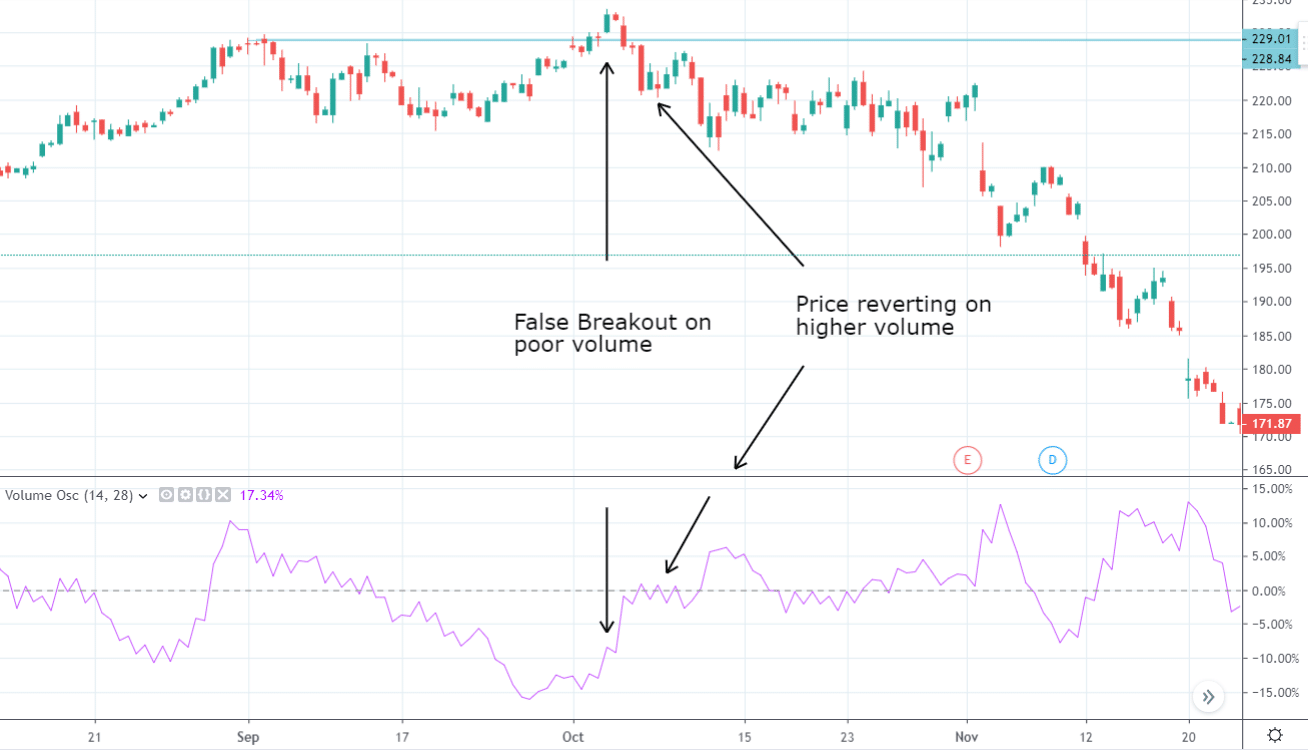
The nautical chart above shows what happened to Apple in Oct 2018. After making a $229.seventy high in September, there was an attempt to break above the loftier in Oct, just the book was weak, as shown by the volume oscillator lying well beneath the zero line. In the following days, the price turned downward, and the book indicator rose above the zero line, indicating the strength in the downwards move. That marked the beginning of a downtrend that lasted till the end of the year.
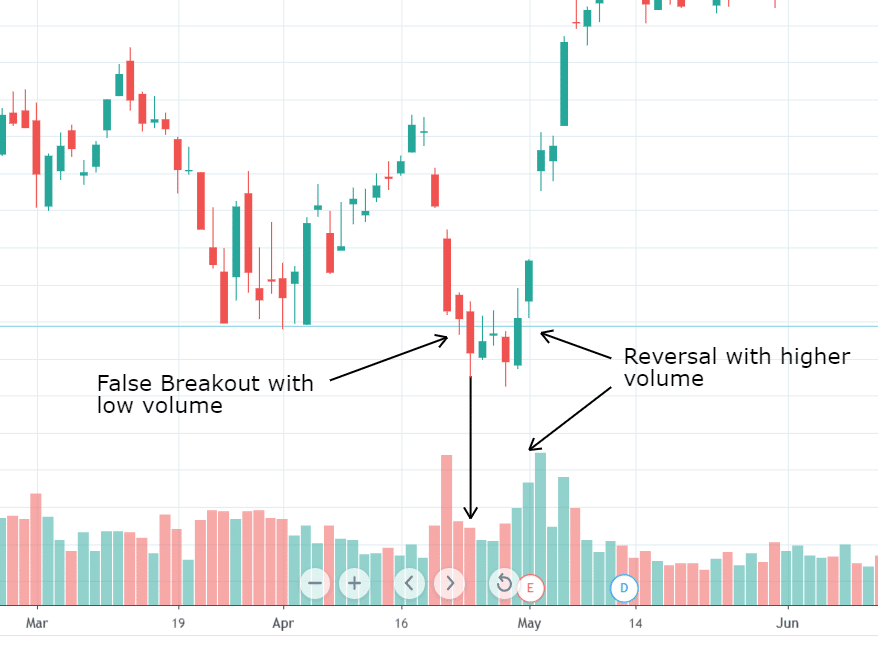
The nautical chart higher up shows Apple tree in the ending of April 2018. Y'all can come across the low book during the attempted breakdown and how in the subsequent sessions, the price turned upwards with a surge in volume (arrows). This was the beginning of the upswing that lasted until October.
Pullbacks
The price of any other security moves in waves: an impulse wave and a corrective wave (pullback). When the market is trending upwardly or downwardly, the impulse wave (in the management of the trend) is larger than the corrective wave (pullback in the opposite direction). But it's hard to tell at the starting time of the opposite move if information technology'southward but a correction or a price reversal.
This is where a volume indicator can help you assess what is happening and how to manage your positions. Moves in the direction of the trend are accompanied by relatively higher volumes than moves in the opposite direction. Additionally, a volume indicator tin can help you recognize when a pullback has completed and the trend resumed.
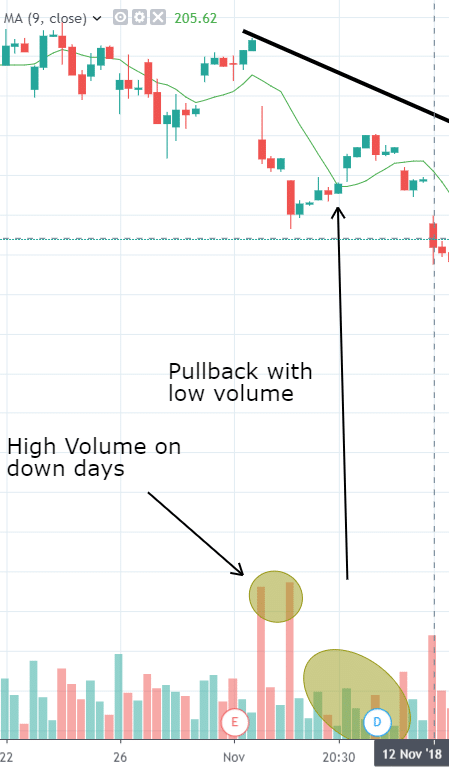
In the nautical chart, you tin run into that there'south a downtrend (trendline and moving average). Notice how the book thinned out when there was a pullback and how it started rising when the downtrend resumed.
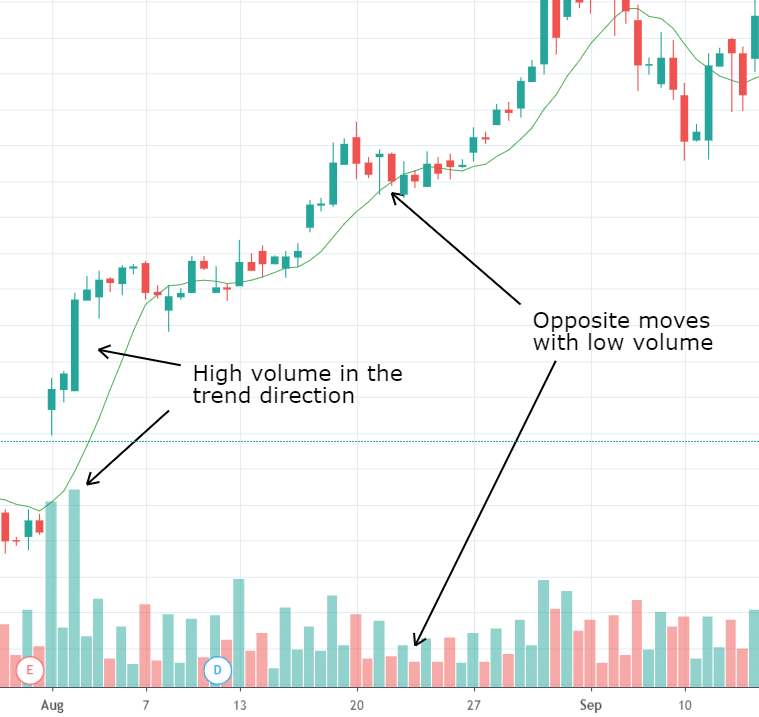
The above chart shows an uptrend. Discover the huge volumes when the toll is going up (first pair of arrows) and how the volume thinned out when the price pulled back (2nd prepare of arrows).
Reversals
After a prolonged uptrend or downtrend, if the price begins to consolidate with relatively smaller cost movements but on heavy volume, there may be a price reversal in sight. It shows that institutional investors are accumulating or distributing positions.
In addition, volume indicators can help ostend toll reversal market structures, such as caput and shoulder, double superlative, and others. The way a volume indicator behaves when the right shoulder of a caput and shoulder pattern is forming can tell a lot about the setup. The same is true for a retest of the high in a double meridian setup. Furthermore, a divergence betwixt the book indicator and the price is a strong reversal signal.
In the above chart, y'all can see a bearish divergence (Arrows), with the price making a higher high while the OBV made a lower loftier. It correctly predicted a downtrend.
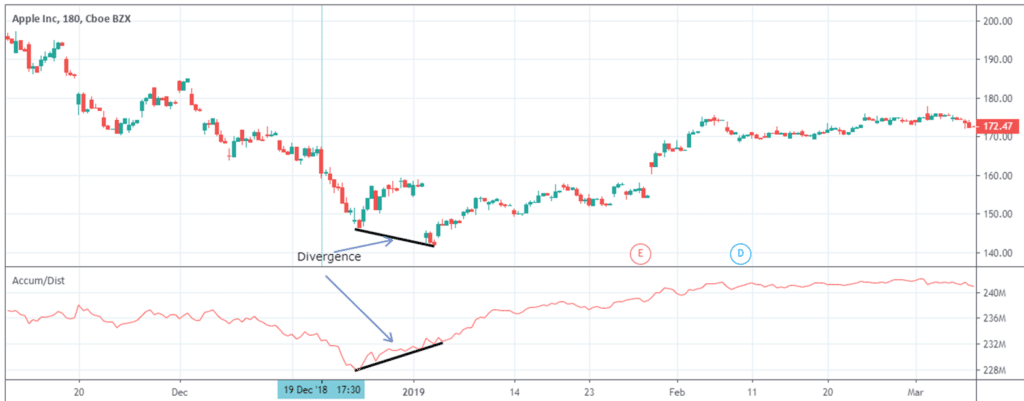
The nautical chart above shows a bullish divergence, with the price making a lower low while the A/D line was ascension. What followed next was a reversal of the trend.
Conclusion
Volume analysis is very important to traders and investors. There are numerous volume indicators out there, but we have discussed some of the commonest ones. Study them and add them to your analysis tools to meliorate your trading.

List Of Forex Volume Indicators,
Source: https://therobusttrader.com/volume-indicators-volume-trading/
Posted by: briminvuld.blogspot.com
0 Response to "List Of Forex Volume Indicators"
Post a Comment